
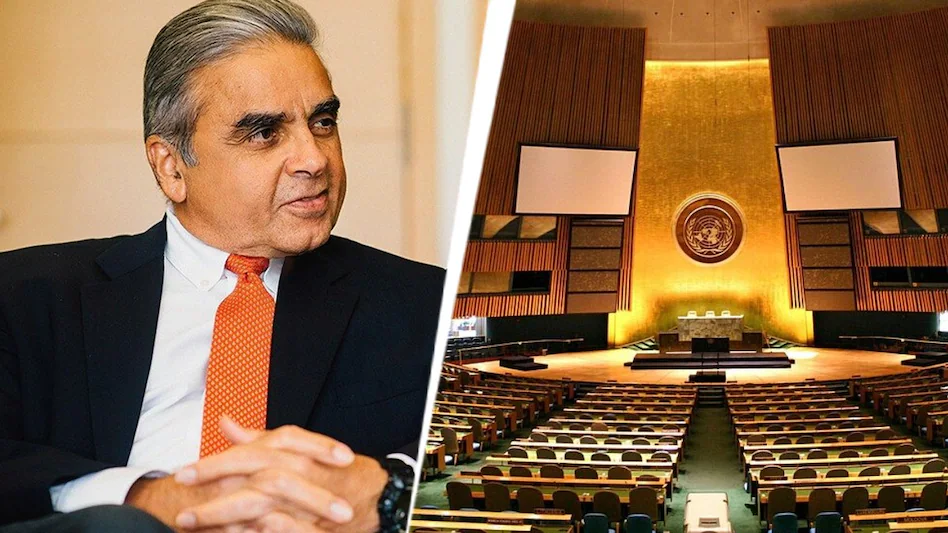
“Time for UK to Step Aside”: Ex-Singapore Envoy Says India Deserves Permanent UN Security Council Seat

Ex-Singapore Envoy Calls for UK to Give Up UNSC Seat to India
The long-standing debate over reforming the United Nations Security Council (UNSC) has reignited, with a striking suggestion from Kishore Mahbubani, Singapore’s former ambassador to the UN.
Speaking in Singapore on August 27, Mahbubani argued that the United Kingdom should vacate its permanent Security Council seat in favour of India, a nation he says better reflects today’s global power balance.
“The UK no longer represents the great powers of the day,” Mahbubani said, adding that India’s rise makes it a far more deserving candidate.
Why the UK Should Step Aside
Mahbubani’s remarks touch on a sensitive but increasingly relevant issue: whether Europe holds disproportionate influence at the UN. Currently, two European countries — the UK and France — hold permanent UNSC seats, alongside the United States, Russia, and China.
Critics argue this setup reflects the power dynamics of 1945, not the realities of the 21st century. At the time the UN was founded, the UK was still a global empire. Today, however, its relative weight has declined.
India, by contrast, is a nation of 1.4 billion people, the world’s most populous democracy, and an economy that has already overtaken Britain’s in size. According to Mahbubani, by 2050 India’s economy could be four times bigger than the UK’s.
India’s Case for a Permanent Seat
India has long sought a permanent seat on the UNSC. Its arguments are grounded in several key points:
- Population: India is home to nearly one-fifth of the world’s people.
- Economy: Now the world’s fifth-largest economy, India continues to climb global rankings.
- Military Power: With one of the largest armed forces in the world, India plays a central role in peacekeeping and security.
- Global Leadership: India is active in international forums like the G20, BRICS, and the Quad, and is increasingly seen as a bridge between the developed and developing worlds.
Supporters say it is illogical for India to remain outside the UNSC’s permanent circle while smaller European states maintain their positions.
The Europe Problem at the UN
Mahbubani did not only target the UK. He criticized Europe’s overall influence at the UN, suggesting that it blocks meaningful reforms.
With both the UK and France holding permanent seats — and the European Union often coordinating its positions collectively — Europe wields outsized power compared to other regions. Africa, Latin America, and South Asia remain unrepresented in the permanent membership, despite their population size and growing global influence.
“The structure of the UNSC still reflects the world of 1945, not 2025,” Mahbubani said. “This imbalance undermines the Council’s credibility and effectiveness.”
Resistance to Reform
Calls for reform are not new. For decades, countries including India, Japan, Brazil, and South Africa have pushed for permanent seats, forming the G4 coalition. However, changes to the UNSC require approval from two-thirds of the UN General Assembly and ratification by all five permanent members (P5).
This makes reform extremely difficult. The P5 nations are reluctant to dilute their own power, and European countries have shown little willingness to voluntarily step aside.
Even within the UN, reform proposals often stall due to competing interests. While many agree that the Council should be more representative, there is no consensus on who should be added or what regional balance should look like.
Why India Matters More Than Ever
Supporters of Mahbubani’s view argue that India’s inclusion would strengthen the legitimacy and authority of the UNSC.
- Democracy Representation: Among the P5, only the US, UK, and France are democracies. Adding India — the world’s largest democracy — would give the Council greater democratic legitimacy.
- South-South Voice: India represents the aspirations of the developing world, particularly the Global South, which often feels sidelined in international decision-making.
- Balance Against China: India’s growing strategic rivalry with China also makes its role at the UNSC crucial in balancing Asian power dynamics.
- Peacekeeping Contributions: India has historically been one of the largest contributors to UN peacekeeping missions, demonstrating its commitment to international stability.
Global Momentum for Reform
The idea of expanding the UNSC has gained momentum in recent years. Both US President Joe Biden and French President Emmanuel Macron have expressed support for India’s bid, though concrete steps remain elusive.
African leaders have also pushed for representation, arguing that an entire continent cannot be excluded from permanent membership. Brazil, as Latin America’s largest nation, has made similar arguments.
Despite this broad recognition of the problem, entrenched interests — particularly among the existing P5 — make change slow.
What Happens Next?
Mahbubani’s call is unlikely to trigger immediate change, but it adds pressure to an already growing debate. By explicitly calling out the UK, he highlights the uncomfortable truth that Europe’s dominance at the UNSC is increasingly hard to justify.
Whether Britain would ever voluntarily give up its seat remains doubtful. Yet the conversation itself matters: as the global balance of power shifts toward Asia and the Global South, institutions like the UN must adapt or risk losing relevance.
The former Singapore envoy’s blunt assessment cuts to the heart of a long-standing issue. The United Nations Security Council, created in 1945, no longer reflects today’s realities. India — with its vast population, growing economy, and global influence — is a glaring omission.
If the UN is to remain credible as a guardian of international peace and security, reform is inevitable. Whether that means expanding membership or asking countries like the UK to step aside, the status quo cannot last forever.
As Kishore Mahbubani put it: “India represents the future. The UK represents the past.”

