
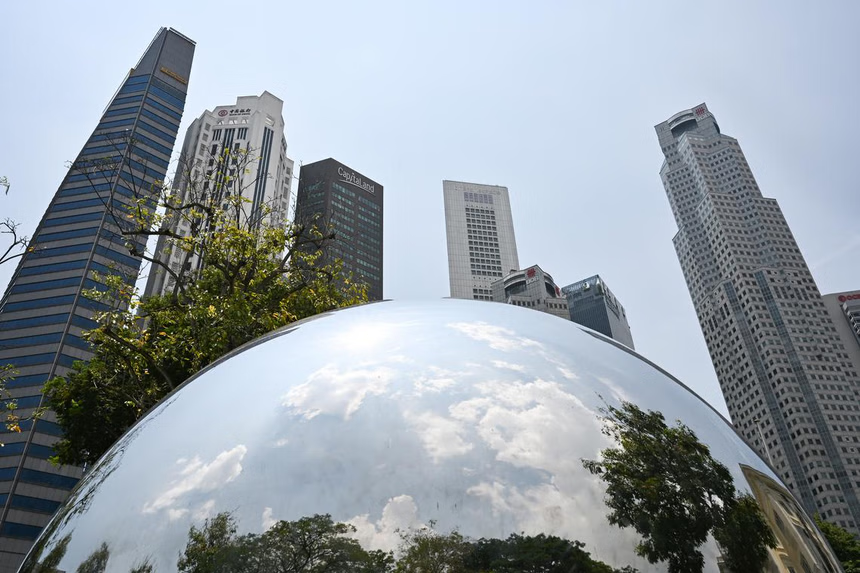
Singapore’s Small Businesses Brace for Turbulence in 2025 After Year of Major Transformation

Singapore’s Businesses Prepare for Challenges in 2025
As Singapore heads into 2025, many local companies are bracing themselves for more uncertainty after a year of restructuring and transformation in 2024. The year was tough for businesses as they faced rising costs, talent shortages, and global economic pressures, forcing many to put their expansion plans on hold.
Rather than aggressively pursuing growth, companies focused on re-engineering their operations to survive in an increasingly challenging environment. But even in this “wait-and-see” mode, businesses didn’t stop investing in their future. Key areas like artificial intelligence (AI), digitalisation, and sustainability became top priorities as they looked to stay competitive and meet global standards.
Business Transformation Amid Uncertainty
For many companies in Singapore, 2024 was a year of survival and restructuring rather than growth. According to Joanne Tan, Deputy Managing Director for Industry at Enterprise Singapore, businesses had to focus on fortifying their operations against high costs and the ongoing shortage of skilled workers.
In a survey by the Singapore Business Federation (SBF), it was revealed that 7% more businesses fine-tuned their digital operations in 2024 compared to the previous year. This indicates that even in a challenging year, many companies in Singapore are prioritizing digital transformation and preparing for the future.
However, these changes weren’t made out of desire—they were a necessity. With increasing costs across many sectors and difficulties in hiring talent, businesses had to adjust their strategies to stay afloat and keep their operations running smoothly.
Why 2025 Looks Turbulent for Singapore’s Businesses
Looking ahead, Singapore’s companies are preparing for turbulence in 2025. Despite the positive signs of economic recovery in 2024, the challenges that businesses face are far from over. Global uncertainties, supply chain disruptions, and cost pressures are still looming large.
This means that businesses will continue to focus on surviving and ensuring their operations are as efficient as possible. Growth and expansion may remain on hold for many as they wait for conditions to improve.
According to the SBF survey, 70% of businesses plan to continue their focus on cost management, automation, and upskilling in 2025, rather than aggressive growth strategies. The key areas they are investing in include AI, digital tools, and making their businesses more sustainable—steps that will ensure they are ready for long-term success even in an unpredictable environment.
Digitalisation: The Key to Future Survival
One of the most significant shifts in 2024 was the acceleration of digitalisation. Many businesses, particularly small and medium-sized enterprises (SMEs), have realised that to remain competitive, they need to modernise their operations with the latest technology. Digital tools help companies become more efficient, cut costs, and adapt to changing consumer demands.
The SBF survey highlights a notable increase in the number of companies fine-tuning their digital processes. About 7% more businesses invested in improving their digital operations in 2024 compared to 2023. Whether it was through integrating new software systems, adopting AI solutions, or improving online customer engagement, businesses recognised that these investments would pay off in the long term.
In addition to improving operational efficiency, embracing digitalisation also helps companies meet global standards. As companies look to expand their reach internationally, having up-to-date digital systems becomes crucial for tapping into new markets and staying competitive.
AI and Sustainability: The Future of Business
Another area that businesses in Singapore are increasingly investing in is artificial intelligence (AI). AI is becoming an integral part of businesses’ strategies to improve everything from customer service to supply chain management. In particular, AI is being used to automate repetitive tasks, enhance decision-making, and provide valuable insights into business operations.
The pandemic has accelerated the adoption of AI across many industries, and as companies prepare for 2025, they are doubling down on these technologies to ensure they are not left behind. In particular, AI helps businesses gain a competitive edge by making operations faster, cheaper, and more efficient.
Alongside AI, companies are also focusing on sustainability—another trend that is gaining momentum. As governments and consumers alike become more environmentally conscious, businesses are recognising the need to align with global sustainability goals. From reducing carbon footprints to adopting more eco-friendly practices, sustainability is no longer optional—it’s becoming a business imperative.
The Role of Small Businesses in Singapore’s Economy
Small and medium-sized enterprises (SMEs) play a crucial role in Singapore’s economy, accounting for 99% of the country’s businesses. With over 300,000 SMEs in Singapore, they are the backbone of the nation’s economy, and their ability to adapt and innovate will determine the future direction of the country’s economy.
For SMEs, 2024 was about survival, but as 2025 approaches, it’s clear that those who continue to embrace digital transformation, invest in AI, and focus on sustainability will be better positioned to thrive. The government has been proactive in supporting these businesses with initiatives that help them adopt new technologies and improve their operations.
The Path Ahead: Adaptation and Innovation
As Singapore enters 2025, businesses will continue to face a turbulent environment. However, the lessons learned in 2024 will help many companies navigate the challenges ahead. In times of uncertainty, the ability to adapt quickly, invest in technology, and focus on sustainability will be key to survival.
The businesses that continue to embrace change and innovation, even when the road ahead looks uncertain, will likely emerge stronger in the long run. With the right investments and strategic planning, Singapore’s companies can continue to drive the economy forward, even in challenging times.
Conclusion: Preparing for 2025 and Beyond
Looking ahead to 2025, businesses in Singapore are preparing for a year that could be filled with challenges. But despite the uncertainties, many companies are positioning themselves for success by focusing on digital transformation, AI adoption, and sustainability.
In the face of rising costs, talent shortages, and global instability, companies are making the necessary adjustments to ensure their long-term viability. While growth may be slow in the short term, Singapore’s commitment to innovation and adaptation will ultimately help businesses weather the storm and remain competitive in the years to come.