
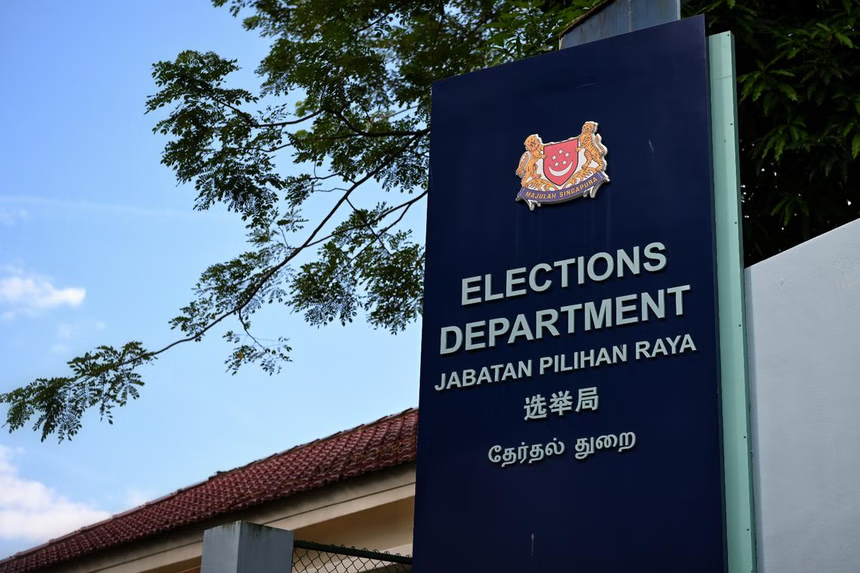

Singapore’s next general election (GE2025) could be closer than we think, with the formation of the Electoral Boundaries Review Committee (EBRC) marking the beginning of a countdown. Prime Minister Lawrence Wong has officially set the wheels in motion, with the committee now tasked with determining the country’s electoral boundaries. But what does this mean for voters, and when can we expect the election?
Let’s break it down.
What is the Electoral Boundaries Review Committee (EBRC)?
The EBRC is a special committee formed to review and adjust the electoral boundaries in Singapore before each general election. The committee’s main job is to ensure that the boundaries reflect population changes, housing developments, and other demographic shifts. The committee also plays a critical role in deciding the number of Group Representation Constituencies (GRCs) and Single-Member Constituencies (SMCs) that will be in place for the upcoming election.
This is a crucial step before voters head to the polls, and the timing of the EBRC’s report is something that everyone is eagerly waiting for.
Why Is the Formation of the EBRC Important?
The formation of the EBRC is an important sign that Singapore is one step closer to GE2025. The committee will review the current electoral map and make recommendations for boundary changes. Once the committee submits its report, it will be passed to Parliament for approval.
This review process is essential to ensure that electoral boundaries reflect population movements across the country, so each constituency has a roughly equal number of voters. The goal is to balance the number of electors in each area while maintaining a fair representation of the country’s diverse communities.
PM Wong convened the EBRC on January 22, 2025, and the committee will now begin its work. While there is no fixed timeline for when the committee will finish its work, historically, the process has taken anywhere from three weeks to seven months.
How Does the EBRC Shape the Election?
Once the committee completes its review, the recommendations will be submitted to Parliament. Parliament will then decide whether to accept the new boundaries. In practice, this means the boundaries may change to reflect population growth or demographic changes in certain areas. For example, new housing developments or shifting population patterns could lead to the creation of new constituencies or the merging of others.
The EBRC typically looks at three key factors when making recommendations:
- The number of electors per constituency: The committee seeks to maintain a balance in the number of voters across constituencies to ensure fair representation.
- The number of Group Representation Constituencies (GRCs): GRCs are multi-member constituencies, and the committee will determine how many such constituencies are needed based on population data.
- The proportion of MPs from SMCs: SMCs are single-member constituencies, and the committee also looks at how many of these constituencies will exist after the boundary review.
When Will the Next General Election Be Held?
The formation of the EBRC is a crucial milestone in the lead-up to GE2025. While no official date for the election has been set, the formation of the EBRC signals that the election is likely to happen within the next year or so. According to Singapore’s laws, the next general election must be held by November 2025.
In previous elections, the time between the formation of the EBRC and polling day has ranged from four to 11 months, so it’s possible that we could be voting as early as May 2025 or even sooner, depending on how quickly the committee can complete its work.
What’s Next for the EBRC?
The EBRC will review the current boundaries, make necessary adjustments, and present a report to the Prime Minister. Here are the steps to watch for:
- Committee’s Work: The committee will consider factors like population growth, new developments, and changes in housing trends to decide if boundaries need to be redrawn.
- Report Submission: Once the committee finalizes its recommendations, the report will be submitted to Parliament. This process typically takes a few months but can vary depending on the complexity of the changes.
- Parliament’s Approval: After reviewing the committee’s report, Parliament will approve or modify the recommendations. This approval will trigger the process of finalizing the boundaries for GE2025.
Once the boundaries are set, the election process will begin in earnest, with candidates officially declared, and voters gearing up for the vote.
Who’s in Charge of the EBRC?
The EBRC is chaired by Tan Kee Yong, the Secretary to the Prime Minister, and comprises five senior civil servants:
- Colin Low – Chief Executive, Singapore Land Authority
- Tan Meng Dui – Chief Executive, Housing and Development Board (HDB)
- Koh Eng Chuan – Chief Statistician, Singapore Department of Statistics
- Lim Zhi Yang – Head, Elections Department (ELD)
- Tan Kee Yong – Chairman of the EBRC
These officials are tasked with ensuring that the electoral boundaries reflect the latest demographic trends and are fair to all voters.
What Happens After the Boundaries Are Set?
Once the report is presented to Parliament and the boundaries are finalized, Singapore will be one step closer to holding its next general election. The formation of the EBRC is a key step in the electoral process, but it’s only the beginning.
After the boundaries are decided, political parties and candidates will begin preparing for the campaign. The election itself will include the familiar voting procedures, and voters will head to the polls to elect their Members of Parliament (MPs).
For Singaporeans, this means the beginning of an exciting election cycle. As the government works to finalize the boundaries and the election date looms, voters can expect more updates about the candidates, the issues at stake, and what the future of Singapore will look like under the leadership of the next generation of MPs.
Conclusion: The Countdown Begins
The formation of the EBRC is a signal that GE2025 is on the horizon. While there is still time before the actual election takes place, the process has now officially begun. As the committee works on redrawing the boundaries and preparing the electoral map, Singaporeans will be keeping a close eye on developments, eager to learn when they will head to the polls next.
The upcoming general election will shape the future of Singapore, and it all starts with the work of the EBRC. As we wait for the committee’s report and the final decision on the boundaries, one thing is clear: the countdown to GE2025 has officially begun.