
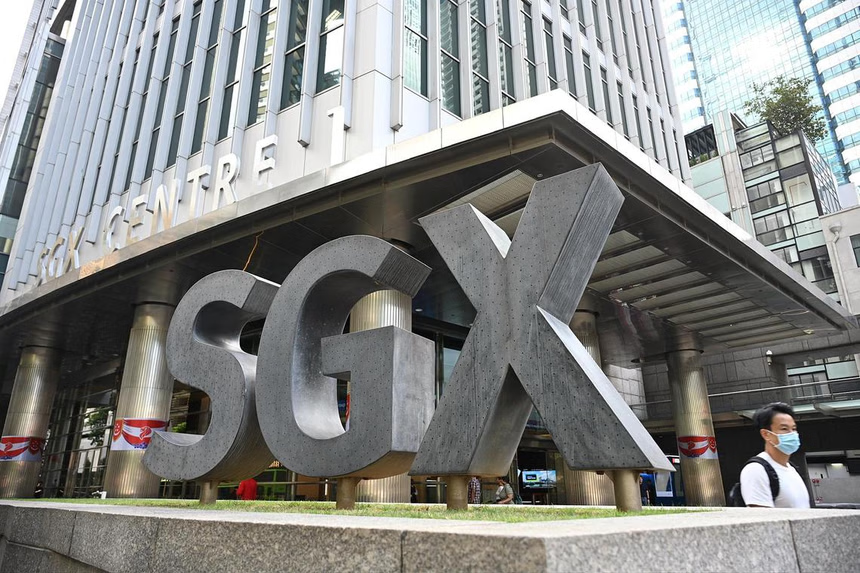
Singapore’s Economy Grows 4.3% in Q4 2024 – Stronger Than Expected, But What’s Next for 2025

Singapore’s Economy Grows 4.3% in Q4 2024, Beating Expectations
Singapore’s economy ended 2024 on a high note, with a 4.3% year-on-year growth in the fourth quarter, according to advance estimates released by the Ministry of Trade and Industry (MTI) on January 2, 2025. While this marks a slowdown compared to the previous quarter’s impressive performance, the growth still exceeded forecasts, showing that Singapore’s economy is more resilient than many had expected.
Let’s break down the numbers and what this means for the future.
Fourth Quarter Growth: A Mixed Bag of Results
In the final quarter of 2024, Singapore’s economy grew by 4.3% compared to the same period in 2023. Though a strong figure, it was slower than the 5.4% growth recorded in Q3 of 2024, and some economists had predicted a more modest 3.8% growth.
Key Highlights:
- 4.3% YoY Growth: The economy expanded by 4.3% compared to Q4 2023, beating expectations.
- 0.1% QoQ Growth: On a quarter-on-quarter basis, Singapore’s economy expanded by just 0.1%, significantly slower than the 3.2% growth in Q3. This suggests that the economy is cooling off a little after a strong run earlier in the year.
Even though the growth rate slowed from the previous quarter, it still demonstrated that Singapore’s economy is in better shape than many thought it would be by the end of 2024.
2024 Full-Year Growth: Strong Recovery After 2023’s Struggles
For the full year of 2024, Singapore’s economy grew by 4%, surpassing the government’s earlier projections and showing a significant rebound from 2023, when the economy grew by just 1.1%.
What Does This Mean for Singapore’s Economy?
- The 4% growth marks the strongest performance since 2021, when the economy expanded sharply due to the post-pandemic recovery.
- 2023’s Sluggish Growth: With only 1.1% growth in 2023, Singapore’s economy faced a tough year, primarily due to global trade challenges, high inflation, and geopolitical uncertainty.
Economists had initially projected that 2024 growth would be around 3.5%, but the economy surpassed that estimate, thanks to stronger-than-expected demand in key sectors like electronics and manufacturing, alongside steady support from domestic consumption.
Looking Ahead: 2025 and the Challenges Ahead
Despite Singapore’s strong performance in 2024, the outlook for 2025 appears more cautious. The MTI has already indicated that growth could slow down to a range of 1% to 3% next year.
What Are the Risks for 2025?
- Geopolitical Tensions: Heightened geopolitical risks, especially from ongoing tensions between major powers like the U.S. and China, could dampen global trade and negatively impact Singapore, which is a hub for trade and finance.
- US Trade Policies: There’s also uncertainty over the incoming U.S. administration’s trade policies, which could affect Singapore’s exports, particularly to the U.S.
- Global Inflation: Persistent inflation and rising interest rates in some parts of the world could lead to weaker consumer spending and impact growth.
These uncertainties make it challenging to predict the precise direction of Singapore’s economy. While the 4% growth in 2024 shows resilience, economists warn that 2025 could bring a period of slower growth.
What’s Driving Singapore’s Economic Growth?
Despite global challenges, several factors have helped fuel Singapore’s economic recovery in 2024. These include:
1. Strong Manufacturing and Electronics Sector
Singapore’s manufacturing sector, particularly in electronics and semiconductors, has remained a key driver of economic growth. The demand for high-tech products continues to grow, providing a steady boost to the economy.
2. Domestic Consumption
While global demand has been mixed, Singapore’s internal market remains robust, with steady consumption and investment. This has been particularly beneficial for sectors like retail, real estate, and hospitality.
3. Government Support
The Singaporean government’s policies have also played a role in supporting the economy, including targeted stimulus measures to cushion the impacts of external shocks and promoting innovation and digitalization.
4. Trade and Finance Hub
As a global financial and trade hub, Singapore has benefitted from regional and international trade flows, especially in the Asia-Pacific region. Its business-friendly environment continues to attract investments, despite global uncertainty.
The Road Ahead: Will Singapore Keep Its Competitive Edge?
Looking into 2025, Singapore faces a more challenging economic landscape. The government has signaled a more cautious approach, with moderate growth expectations. However, Singapore’s role as a key financial and trade hub in Asia means it’s likely to continue attracting investments, even in a slower-growth environment.
As always, much of Singapore’s economic performance will depend on global market conditions, trade flows, and business confidence. With its strong fundamentals and ability to adapt to changes, Singapore will likely weather the challenges ahead, though growth could be more subdued compared to the past year.
Conclusion: A Year of Resilience, but Tough Times Ahead
2024 was a strong year for Singapore’s economy, with growth surpassing expectations at 4%. The 4.3% growth in Q4 marked the end of a challenging year on a positive note, but economists are cautious about the outlook for 2025, citing geopolitical risks, US trade policies, and global inflation as potential challenges.
While Singapore is well-positioned to navigate these uncertainties due to its strong economy and business-friendly environment, slower growth in 2025 is likely. As always, keeping an eye on global trends will be key for understanding Singapore’s economic trajectory in the coming year.