
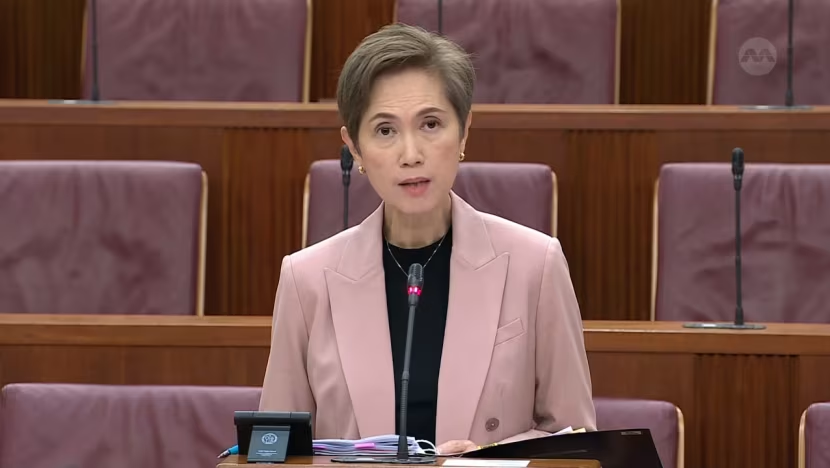
Josephine Teo Opens Up About Activists Using Meet-The-People Sessions for Advocacy

Minister Josephine Teo Reveals Ambush Incidents at Meet-The-People Sessions
In a recent Facebook post, Minister for Digital Development and Information Josephine Teo shared her personal experiences at the Meet-the-People Sessions (MPS), revealing how some individuals have used these platforms not to seek help, but to promote their own advocacy issues. Her comments came after Home Affairs and Law Minister K Shanmugam publicly discussed similar incidents the day before.
Teo’s revelation has sparked a conversation about the use of MPS, traditionally seen as a way for residents to raise personal concerns and seek assistance from elected Members of Parliament (MPs). The post highlights a growing trend where activists attend these sessions, not as constituents, but as a way to use the MPs’ time for political or advocacy purposes.
The Meet-the-People Sessions: A Platform for Advocacy or Help?
What Are Meet-the-People Sessions?
Meet-the-People Sessions (MPS) are an essential part of Singapore’s political and community engagement. They serve as an open platform where residents of a constituency can meet their local MPs to discuss personal issues, seek help, or raise concerns. This practice has long been an integral part of Singapore’s political system, designed to ensure that MPs are accessible and responsive to the needs of their communities.
However, in recent times, these sessions have become a target for individuals who aren’t looking for assistance, but are instead using the opportunity to push for their own political agendas or activism.
Teo’s Experience: A Personal Account of MPS ‘Ambushes’
Josephine Teo recounted two separate incidents in which she witnessed individuals coming to her MPS sessions, not with personal issues, but to push specific causes. In her Facebook post, Teo explained how these activists knew that MPS would provide them with guaranteed access to MPs, and in some cases, they weren’t even residents of her constituency.
“I had not intended to talk about these incidents publicly, but after what happened to Minister Shan recently, I felt compelled to speak out,” Teo said, referencing the similar incidents faced by K Shanmugam the day before.
Teo’s revelation follows K Shanmugam’s account of activists coming to his MPS with issues unrelated to personal assistance, turning what was meant to be a constructive platform into a stage for political messaging. The similarities between their experiences have raised questions about whether these sessions are being hijacked by individuals seeking publicity for their causes, rather than providing a service for the people who need it most.
K Shanmugam’s Encounter: A Precedent for Teo’s Experiences
What Happened to Minister K Shanmugam?
Just a day before Teo’s post, K Shanmugam, Singapore’s Home Affairs and Law Minister, shared his own experience with activists using MPS for advocacy purposes. Shanmugam explained how people showed up at his session, not to seek help, but to publicly advance specific political views or criticize government policies.
This sparked a wider conversation about the original intent of the MPS, as people began to question whether it was being exploited for non-constituency-related purposes. In his statement, Shanmugam expressed frustration with how these individuals diverted the focus of the session from helping people to pushing their own agendas.
Shanmugam’s comments resonated with Teo, who then decided to share her own encounters with similar issues, underscoring that this was not an isolated incident, but rather a growing trend. Both ministers now find themselves grappling with the challenge of maintaining the integrity of MPS in the face of increasing political activism.
Why This is a Growing Concern
The Disruption of Community Services
The primary concern with activists using MPS for advocacy is the potential disruption of the service meant for constituents who genuinely need help. The sessions were never intended to be political events but rather a space for ordinary residents to bring up personal issues, ranging from social support to legal assistance.
When activists attend these sessions and use them for their own causes, it not only distracts MPs from their main duties but can also diminish the effectiveness of these platforms for those who need genuine assistance. It also raises questions about the ethics of using such sessions as a political tool.
A Growing Trend of Political Activism
The incidents recounted by both Teo and Shanmugam are part of a broader shift in the way MPS is being perceived. What was once a straightforward service platform has increasingly become a battleground for political ideologies and activist campaigns. The rise of political activism in Singapore has led some individuals to see MPS as an opportunity to voice dissent or push agendas, which can cause tension and undermine the platform’s purpose.
This situation creates a dilemma for MPs, who are now faced with balancing their duties to assist their constituents with the need to manage political discourse. With more activists seeking to use these sessions for advocacy, the question arises: How can the government and MPs preserve the integrity of MPS while still allowing room for diverse views?
Teo’s Response: How Should MPs Navigate This Issue?
Keeping MPS Focused on the People’s Needs
While acknowledging the activism taking place at MPS, Josephine Teo emphasized the importance of keeping the sessions focused on community needs. The core purpose of MPS is to provide a channel for residents to seek help and express genuine concerns. Teo’s view is that MPs should continue to engage with those who need assistance while ensuring that the session remains a productive and helpful platform.
At the same time, Teo’s experience raises questions about how MPs should handle advocacy and activism in MPS. Should they continue to entertain political discussions, or should these individuals be redirected to other forums designed for political discourse?
Addressing the Need for Better Communication
Teo also pointed to the need for clear communication with the public about the purpose of MPS. While these sessions are intended to offer help, there should be a better understanding of what MPS is meant for. By setting clearer boundaries, MPs may be able to create a more focused and productive environment for residents who need their assistance, while also ensuring that political debates take place in appropriate spaces.
The Future of Meet-the-People Sessions
As more activists make their voices heard at Meet-the-People Sessions, the role of MPs in managing these interactions becomes more complex. While these sessions remain an important tool for addressing residents’ needs, there is a growing need for clarity and boundaries regarding their use.
Josephine Teo’s decision to speak out, following K Shanmugam’s experience, sheds light on the increasing tension between activism and service in Singapore’s political landscape. The future of MPS will depend on how MPs and the government can balance these competing demands—ensuring that the sessions stay true to their original purpose while also allowing space for political engagement when needed.

